Indian Cuisine

INDIAN FOOD

Very fine meals that suit the various taste buds of people all over the world are prepared in India. Strict vegetarianism is mostly confined to the South. Beef, from the holy cow is strictly taboo for the Hindus and Pork is equally taboo for the Muslims.

In the north, much meat is eaten and cooking is often of the "Mughal style" which bears relation to that of the Middle East and central Asia. The emphasis is more on spices and less on curry heat. In the north more grains and breads are eaten and less rice. In the South, more rice is eaten and the curries tend to be hotter. Another peculiarity of Southern vegetarian food is that it has to be eaten by hand and not by fork and spoons!

Curry and Spices


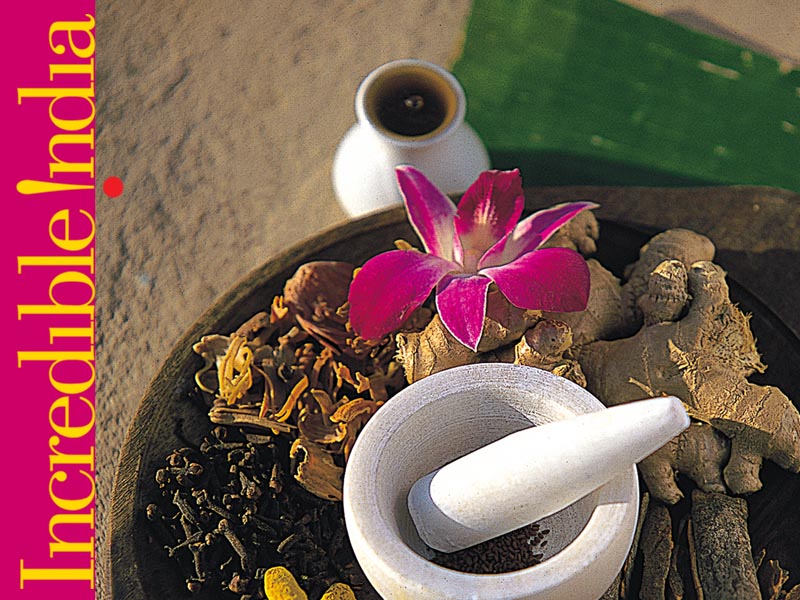
There is no such thing as "curry" in India. It is an all-purpose term devised by the English to cover the whole range of Indian food spicing. Indian cooks have about 25 spices on their regular list and it is from these that they produce curry flavor. Normally the spices are freshly ground in a mortar and pestle called SIL_VATTA. Spices are usually blended in certain combinations to produce meals. Garam Masala, for example is a red-hot combination of cloves and cinnamon with peppercorns.
Popular spices include saffron, an expensive flavoring produced from flowers. This is used to give biryani, that yellow color and delicate fragrance. Turmeric also has a coloring property and acts as a preservative. Chillies are ground, dried or added whole to give that hot taste to curries. They come in red and green varieties but the green ones are the hottest. Ginger is supposed to be good for digestion. Coriander is added to many masalas so as to cool the body. Cardamom is used in many sweet dishes and in meat preparations. Other popular spices are nutmeg, cinnamon, poppy seeds, caraway seeds, cumin seeds, fenugreek, mace, garlic and cloves.

Breads


Rice is the staple food of the Indians but it is given much importance only in the South. The best Indian rice is the famous Indian Basmati whose patenting has raised a lot of dust and is still under controversy. It is predominantly grown in the Dehra Dun Valley. It has long grains, is yellowish in color and has a slight sweetish or "bas" smell, which gives it its name.
In the north a range of breads called ROTIS or PHULKA in Punjab supplements this rice. Indian breads are varied but they are always delicious. Simplest form is the Chapatti, just Wheat flour and water fried up like a thin pancake. It is supposed to be a British invention. Rotis are flour and water cooked on a hot tawa. Direct heat blows them up, but how well depends on the glutin content of the wheat. Baste your roti in butter or ghee and it becomes a paratha. If deep-fried it is called poori in the north and loochi in the east, made of rice and black gram flour it is called dosa in the South. Dosas are found all over India and when wrapped around curried vegetables it becomes masala dosa, a nice snack. Another type of deep-fried bread with a stuffing is the Kachori. Bake the bread in an oven and it becomes Naan. An Idli is a kind of rice dumpling, often served with dal curry called sambar, a south Indian favorite and green chilly chutney. Tomato or Onion chutneys also go with it. Papadams are crispy deep-fried wafer often served with Thalis or other meals.

Basic Dishes

Curries can be made of vegetables, fish, meat, chicken, lamb, and pork. Mostly vegetable oils are used for this purpose. These curries are accompanied by rice in the South and Rotis in the north. Probably the most basic of Indian dishes is Dhal. Dhal is almost there everywhere whether as an accompaniment to a curry or with rice and chapattis. The favorite dhal of Bengal and Gujarat is yellow arhar; in Bengal channa is also yellow; mung is green, rajma is Heinz. Altogether there are 57 varieties of dhal available in India.

Tandoori and Biryani


Tandoori food is northern specialty and refers to the clay oven in which the food is cooked after first being marinated in a mixture of yogurts and spices. Tandoori chicken is a special favorite in many places.
This food is not very hot and usually tastes terrific. Biryani is a Mughal dish. Chicken Biryani is mostly the best favored. Here the meat is mixed with deliciously flavored, orange colored rice, which is spiced with nuts and dry-fruits. A Pulao is a simpler version of the biryani. These biryanis are not too hot like most of the curries

Regional specialties


Rogan Josh is a curried lamb popular in Kashmir where it originated and also in most parts of northern India. Guntaba, pounded and spiced meat balls cooked in a yogurt sauce is also a Kashmiri specialty. Still in the north, Chicken Mahanwala is a rich dish cooked in a butter sauce. Many coastal areas have excellent seafood, including Bombay, where the Pomfret, a flounder-like fish, is popular. Bombay Duck, another fish dish is also famous in Bombay. Dhansak is a Parsi specialty found in Bombay, lamb or chicken cooked with curried lentils and steamed rice. Goa has excellent fish and prawns. Further South in Kerala, all varieties of prawns and crabs and a lot of fish are available.

Another famous Indian dish is the Kababs. These are found all over north India with a lot of variations. The two main forms are Sikka (skewered) or Shami (wrapped). In Calcutta Kati kababs are a local favorite. Further south in Hyderabad, Hallen, pounded wheat with lightly spiced mutton gravy is available. The Andhras are noted for their heavily chillied food. In Tamilnadu Pongal made of cooking rice with jaggery is a specialty. Equally notable is the "vada", made of Black gram dhal flour or Bengal gram dhal mixed with chillies and lots of onions. These two always find their place in the menu of any Tamil family.

Side dishes


Indian food has a number of side dishes to go with the main meal. Probably, the most popular is the Dahi- or curd or yogurt. It has the ability to cool the stomach after a very hot meal. Curd is also used in making Desserts and in the popular drink Lassi. Raitha is another popular side dish where with curd a lot of vegetables in raw form or curried vegetables are mixed. Particularly tomato and cucumber is used. Sabzi are curried vegetables, bhartha is pureed or minced vegetables, and bhujjas are fresh vegetables. India is also famous for a variety of pickles. They come in all flavors, lime, mango, ginger, onion, mixed vegetables, chili, alloo, etc., and in a number of combinations of the above mentioned.
Thalis

A thali is the all-purpose Indian vegetarian dish. Although it basically belongs to south India, it is found in the north too. There are regional variations also. The name comes from the "thali" dish in which it is served. The Thali consists of a metal plate with a number of small metal bowls known as Katoris on it. Sometimes the small bowls are replaced by small indentations on the plate itself. Mostly the plate is a big Banana leaf.

A thali consists of a variety of vegetable curry dishes, relishes, a couple of papadams, puris or chapattis and a whole lot of rice. A deluxe variety would include a Pata, a rolled betel leaf stuffed with fruit and nuts. It may also include curd and one or two Desserts. The main plus points of thalis are they are cheap and 100% filling. Moreover the rice is unlimited for the Gourmet.

Snacks


Samosa, tasty little curried vegetable snacks fried up in a pastry triangle, are found all over India. Bhelpuri is a popular snack in most of the cities, one, which is sold in peddled, carts in the nights. Chana, spiced chick peas served with puris is also a roadside favorite. Chat, a general term for snacks and nibbles is now found in good packs to suit all tongues and pockets.

Western Food


The western foods available for breakfast include Bread Toast and Jam, Bread with butter or Cheese, all types of egg like omelette, fried eggs, bulls-eye and a lot more, the types that can be prepared with little effort. One western food that the Indians have come to terms 100% is the French Fries, which we Indians call, the chips. Calcutta and Bombay have a small Chinese population so Chinese foods can be had in the major cities with a little search. In the north where the Tibetans have settled in many places Tibetan restaurants are present as in places like Dharamsala, Manali and Srinagar.
Desserts and Sweets

Indians are said to have a sweet tooth and an amazing collection of sweets are available to satisfy them. Kulfi is a widely acceptable dessert, a sort of Indian representation of ice cream. Of course, good quality ice creams are also available from a number of leading brands all over the country. Rasgullas are another popular type of Dessert, sweet little balls of rose-flavored cream cheese.
Desserts are mainly rice or milk puddings in sweet syrup or sweet pastries. Gulab Jamuns are small round balls made of flour, yogurt and ground almonds. Jalebi are pancakes in syrup. Milk dishes are usually boiled until the liquid has been removed and then the various ingredients are added to desserts like barfi, which has coconut with almond or pistachio flavoring. Sandesh is a variety of milk dish popular in Calcutta. Payasam as it is called in the south is made from milk simmered with crushed cashews, cereals and sugar, topped with raisins. Firnee is a rice pudding dessert with almonds, raisins and pistachios.

Many of the Indian sweets come with a coating of silver paper, which is edible. Halwa, a translucent, vividly colored sweet belongs to Tamilnadu, particularly the Tirunelveli District. Grinding wheat for a long time and then boiling the ground paste with sugar and seasoned with a lot of nuts makes it.


Fruits

India boasts of a wide variety of fruits, fresh from the gardens. The collection varies all the way from tropical delights in the south to apples, apricots and other temperate region fruits in the north. Cherries and strawberries are available aplenty in Kashmir, and apricots in Ladakh and Himachal Pradesh. Apples are found all over the northwestern part but particularly in the Kulu Valley of Himachal.

Melons are widespread in India, particularly watermelons that are fine thirst quenchers. Mangoes and bananas are found in many parts of India; Pineapples in Assam, Oranges in Kerala, tangerines are widespread in Central India, particularly the hot season.

Paan


An Indian meal finishes with Paan- the name given to the collection of spices and condiments chewed with betel leaves. Found throughout eastern Asia, Betel is mildly intoxicating and addictive. But after a meal it is taken as a mild digestive in small amounts. Paan sellers have a number of little trays and containers in which they mix either sadha or Mitha (sweet) paans. The ingredient may include apart from the betel nut itself, lime paste, various spices and even a dash of opium for a better price. The whole concoction is folded up cleverly and chewed.
Drinks Non - Alcoholic

Tea is the most popular drink in the north, while in the south, coffee is the number one drink. "Tray Tea", which gives you the tea, milk and sugar separately is the most commonly available form of tea in most of the sophisticated hotels in India. Nimbu Paani, which is nothing but lemon squash is commonly available in all the towns, particularly in the summer. A number of branded soft drinks like Pepsi, Coca-cola, sprite, seven-up, etc have cropped up in recent times, and they seem to quench ones thirst though they are said to have only artificial contents with high sugar content. Apple juice drinks are widely available in Himachal Pradesh. Coconut milk, straight from the young coconut, is a popular street-side drink. Another escape from soft drinks is the plain soda, which is widely available. Finally there is the Lassi, that cool, refreshing and delicious iced curd drink.

Drinks - Alcoholic


Alcohol seems to be little expensive in India. In some states like Goa, it is very cheap, whereas in some states like Tamilnadu, it is very expensive. Indian Beers to mention are Golden Eagle, Rosy Pelican, Cannon Extra Strong, Kingfisher, etc., Beer and other interpretations of western alcoholic drinks are known as Indian Made Foreign Liquor (IMFL). Local drinks are called country Liquor and include Toddy, a mildly alcoholic extract from coconut palm flower, and Feni, a distilled liquor produced from Fermented cashew nuts or from coconuts. The two varieties taste differently.

Join us at  India Forum

Delhi is The capital and Best city of India

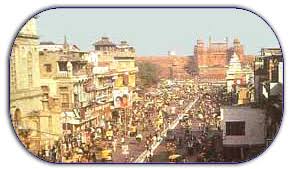
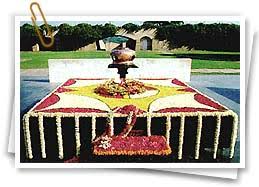
Delhi is the capital of India and the heart of the Nation. Walk into the majestic capital city New Delhi and you soar high, feeling the attraction of the surroundings. The India Gate pays deference to the soldiers who laid their lives for India in the Afghan war. The Raj Ghat glorifies the memories of Father of the Nation, Mahatma Gandhi. The other historical moments like Red Fort, Qutab Minar, Humayun's Tomb, Lodhi Gardens, Chandni Chawk etc. stand in pride to enliven the Mughal era and Indo-Islamic architecture in India. The Rashtrapati Bhawan and other modern building, shopping centres, Metro Project and huge flyovers present a perfect blend of modernity with tradition. 
Delhi as a city has faced many wars, witnessed many thrones and seen many heirs moulding the city in their own way. Still Delhi has resumed its capital status again and again. Today Delhi has two distinct projections that wait for a tourist. Whereas the Old Delhi represents Delhi of Mughal empire with narrow and crowded roads with monuments like Red Fort, Chandni Chawk etc.; New Delhi is an educational, political and administrative hub of India.
Places you can visit while in Delhi:
 
Rashtrapati Bhawan 

Rashtrapati Bhawan Architecturally an impressive building, Rashtrapati Bhawan stands at a height competitive to the India Gate. This stretch is called the Rajpath where the Republic Day parade is held. Perfectly designed by Edwin Lutyens, its charisma does not fade away whether in summer or winter.

India Gate
INDIA GATE India Gate is a memorial raised in honour of the Indian soldiers martyred during the Afghan war. The green, velvety lawns at India Gate, particularly, offer a popular evening and holiday rendezvous for young and old alike.

Laxminarayan Temple 

Laxmi Narayan Temple Popular as the Birla Mandir, the Laxminarayan Temple was built by the Birla family in 1938, encompassed by a large garden and fountains behind it. The temple attracts thousands of devotees on Janmashtami day, the birthday of Lord Krishna. The Father of the Nation, Mahatma Gandhi, was assassinated in this temple complex in 1948.

Humayun's Tomb
Humayun's Tomb was built in 1565, nine years after Humayun's death by his wife Haji Begum. Designed by a Persian architect named Mirak Mirza Ghiyas, the edifice was a trendsetter of the time. It is believed that all later Mughal monuments, including the Taj Mahal, followed the suite.

Qutub Minar 

Qutub Minar Located at a small village called Mehrauli in South Delhi, it was built by Qutub-ud-din Aibek of the Slave Dynasty, the ruler of Delhi in 1206. A fluted 72.5 metres red sandstone tower is covered with intricate carvings and verses from the holy Qur'an. Qutub-ud-din Aibak began the construction of this victory tower as a sign of Muslim domination of Delhi to call the faithful to prayer. However, only the first storey was completed by Qutb-ud-din. The other storeys were built by his successor Iltutmish. The two circular storeys in white marble were built by Ferozshah Tughlaq in 1368, replacing the original fourth storey.

The projected balconies in the tower are engraved by exquisite stalactite designs. The bands of calligraphic inscriptions are amazing in perfection with the exquisite stalactite designs seen on the exterior of this tower.

The Qutub Minar is a historical landmark as it is the first monument of Muslim rule in India, also the edifice pioneering the Indo-Islamic architecture in India.


Red Fort 

Red Fort The Old Delhi projects an image just contrast to the one projected by New Delhi . Undoubtedly, Old Delhi gives an insight into the multifarious culture that aptly characterizes India. Narrow and overcrowded lanes, yet throbbing with life may be repulsive for you. Contrary to this, is the undying attraction of Red Fort that captures your attention. Made in 1639, when Shahjahan decided to shift his capital to Delhi. Within eight years, Shahjahanabad was completed with the Red Fort-Quila-i-Mubarak (fortunate citadel)- Delhi 's seventh fort.

Chandni Chowk 


The living legacy of Delhi is Shahjahanabad. Created by Shahjahan, this city, with the Red Fort and Jama Masjid as the principal landmarks, has a fascinating market planned to shine under the light of the moon, called Chandni Chowk. Shahjahan planned Chandni Chowk market for his daughter. Divided by canals filled with water, this place glistened like silver in the moonlight. The canals are now closed, but Chandni Chowk remains Asia's largest wholesale market till date. Crafts once patronized by the Mughals continue to flourish in the small lanes of the city. An experience of timelessness awaits you at Shahjahanabad.

Raj Ghat 


On the bank of the legendary Yamuna, there is Raj Ghat-the last resting place of Mahatma Gandhi, the father of the nation. It has become an essential point of call for all visiting dignitaries. Two museums dedicated to Gandhiji are situated nearby.

Shanti Vana
Beside the Raj Ghat lies the Shanti Vana (literally, the forest of peace), the place where India 's first Prime Minister Jawaharlal Nehru was cremated. The area is now a beautiful park adorned by trees planted by visiting dignitaries and heads of state.

Bahai Temple (Lotus Temple)
The Bahai Temple, situated in South Delhi resembles a lotus. It is an eye-catching edifice worth exploring dedicated to Bahai community. It offers the visitor a serenity that pervades the temple and its artistic design.

Purana Quila
The Purana Quila is a fort signifying the medieval military architecture. Built by Humayun, with later-day modifications by Sher Shah Suri, the Purana Quila is a fortress of bold design. Purana Quila is also different from the other forts of the Mughals, as it does not have a complex of palaces, administrative and recreational buildings, as is generally found in the forts built later on. The main purpose of this fort was its utility rather than decoration.

The Qal'a-I-Kunha Masjid and the Sher Mandal are two important monuments inside the fort.


Tughlaqabad 


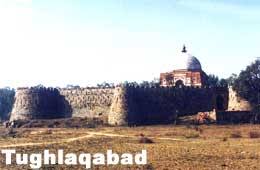
Ghazi Malik built the strongest fort in Delhi at Tughlaqabad, when he founded the Tughlaq Dynasty in 1321. He completed it within four years of his rule. It is said that Ghazi Malik, when only a slave to Mubarak Khilji, had suggested this rocky prominence as an ideal site for a fort. The Khilji Sultan laughed and suggested that the slave build a fort there when he became a Sultan. Ghazi Malik as Ghiyasuddin Tughlaq did just that-Tughlaqabad is Delhi's most colossal and awesome fort, even in its ruined state. Within its sky-touching walls, double-storied bastions, and gigantic towers were housed grand palaces, splendid mosques, and audience halls.
Places at short distances from Delhi:
Neemrana:
It is one of the oldest heritage resorts of India. This fort-palace is situated on a majestic plateau of the Aravalli ranges and was built in 1464 A.D. by Prithviraj Chauhan lll.

Kesroli: 

It is located in the heart of the 'Golden Triangle' and makes an ideal base to visit the neighboring palaces, museums and sanctuaries of Alwar and Sariska.

Mud Fort:

 
Mud Fort At a distance of 80 kms from Delhi, this fort is situated in the lush green surrounding of U.P. The banks of Brijghat, 24 kms away on the holy Ganges , make an interesting picnic outing among fields of sugarcane and mango orchards.

Sultanpur:
This bird sanctuary is situated at a distance of 46 kms from Delhi. Here you can see a variety of domestic and migratory birds. The Shallow Lake near the sanctuary becomes a great attraction for the tourists.

Tilyar Lake:
It is a popular picnic spot located at 70 kms from Delhi . Tourists can enjoy activities like boating and horse riding. Children's Park and a mini-zoo are also attached to the place.

Badhkal Lake: 

Badhkal Lake This lake is situated at a distance of about 32kms from Delhi, in the district of Faridabad.It is a popular picnic spot and is surrounded by beautiful gardens and overwhelming serenity.

Surajkund:

Suraj Kund The premises of the Surajkund have a perennial lake surrounded by rock-cut steps. The place is popular for a big fair, which takes place in the first two weeks of February. Surajkund is situated at a distance of about 11kms from the Qutab Minar on the Mehrauli-Badarpur road. 


Dr APJ Abdul Kalam

AP J Abdul Kalam ia a 200 percent Proud Indian. That's how colleagues of one of India's best-known scientists knew him even before his nomination for presidency. Today multi-faceted Avul Pakir Jainulabdeen Abdul Kalam is best known as the father of India's missile programme. Honoured with numerous awards by the Indian Government including the Bharat Ratna in 1997, Kalam has served the Indian Government in various capacities, including serving as Principal Scientific Advisor to the Government of India with the rank of a Union Cabinet Minister from November 1999 to November 2001. Abdul Kalam was born in a middle-class Tamil family at Dhanushkodi in Rameswaram district of Tamil Nadu on October 15, 1931. While his father Jainulabdeen Marakayar, who rented boats to fishermen for a living, did not have much formal education, Kalam says he inherited honesty and self-discipline from him. After a fairly secure childhood, during which he is said to have read as much as he could, he studied at the Madras Institute of Technology, where he specialised in Aero Engineering. He has worked in leading defence and space organisations in research and managerial capacities. He contributed in a major way to the development of the Satellite Launch Vehicle (SLV) III, which put the Rohini Satellite into orbit. He has also been chairperson to Technology Information, Forecasting and Assessment Council (TIFAC). A vegetarian, his interests include playing the veena and writing poetry. He has written two books, Ignited Minds: Unleashing the Power Within India and India 2020: Vision for the New Millennium. Till now, Abdul Kalam has been best known for his key role in the nuclear tests at Pokharan in the Rajasthan desert on May 11 and 13, 1997. With most parties choosing him as their presidential candidate, he has become the 11th Indian to join a very select group.


Full Name: Avul Pakir Jainulabdeen Abdul Kalam
Date of Birth: October 15, 1931
Place of birth: Dhanushkodi,now in TamilNadu
Father: Jainulabdeen Marakayar
Mother: Ashiamma
School: Schwartz High School, Ramanathapuram


Career of APJ Abdul Kalam

College: St Joseph's College, Tiruchirapalli, MIT, Madras
1950: Joined St Joseph's College, Tiruchirapalli for a BSc degree
1954- 57: DMIT in Aeronautical Engineering at the MIT, Madras
1962: Posted at Thumba Equatorial Rocket Launching Station
1963: Joined ISRO
1964: Joined DRDO as a technical assistant
1968: Formed the Indian rocket Society
1973: Appointed Project Director of SLV-3
1975: Shifted to DRDO
1979: Successful launch of SLV-3 launch on August 10 with Kalam as Mission Director
1980: Second mission of SLV-3 successful too
1981: Awarded Padma Bhushan
1982: Rejoined DRDO, conceived the Integrated Guided Missile Development Programme (IGMDP) for indigenous missiles
1982: Appointed Director DRDL
1983: Missile programme launched
1985: Trishul test-fired
1989: Agni test-fired
1992: Appointed Scientific Adviser to Defense Minister and Secretary, Department of Defense Research & Development
1997: Awarded Bharat Ratna
1998: Underground nuclear tests near Pokharan on May 11
1998: Appointed Principal Scientific Advisor to the Government of India
1998: Writes India 2020: A Vision for the New Millennium with YS Rajan
1999: AGNI-II missile system successfully tested in April
1999: Polar Satellite Launch Vehicle launched on 26 May
1999: Kalam-Raju stent developed for maintaining the coronary blood flow after the angioplasty
2001: Retires as Principal Scientific Advisor to the Government of India
2001: Joined Anna University
2002: Writes Ignited Minds
2002: Elected President of India

Interviews and Famous speeches of APJ Abdul Kalam

"Unless India stands up to the world, no one will respect us. In this world, fear has no place. Only strength respects strength"
 
As a devout Muslim, he prays twice a day. But he is also a Ram bhakt, plays the veena, loves the shri raga, writes poetry in Tamil and, like every proud Indian, swears by Pokhran II and self sufficiency in science and technology. At 67, Dr A.P.J. Abdul Kalam, is not just another Dr Strangelove having a torrid affair with the bomb. He is clever, sensitive, amazingly creative and, above all, a soft spoken patriot. India's answer to Western technological arrogance.


Q: What is your vision of India in the next millennium?

I have three. Three visions for India. But before that I speak about them, I have one question to ask of you, Mr Nandy. Can you tell me why, in 3000 years of our history, people from all over the world have come and invaded us, captured our land, conquered our minds? From Alexander onwards. The Greeks, the Portuguese, the British, the French, the Dutch, all of them came and looted us, took over what was ours. Yet we have not done this to any other nation. We have not invaded anyone. We have not conquered anyone. We have not grabbed their land, their culture, their history and tried to enforce our way of life on them. Why? Because, I guess, we respected the freedom of others. Absolutely right. That is why my first vision is that of freedom. I believe that India got its first vision of this in 1857, when we started the war of independence. It is this freedom that we must protect and nurture and build upon. If we are not free, no one will respect us.

My second vision for India is development. For fifty years we have been a developing nation. It is time we saw ourselves as a developed nation. We are among the top five nations of the world in terms of GDP. We have a 10 per cent growth rate in most areas. Our poverty levels are falling. Our achievements are being globally recognised today. Yet we lack the self confidence to see ourselves as a developed nation, self reliant and self assured. Tell me, Sir, is this right? Read the last chapter of my book, India 2020, A Vision for the Next Millennium and you will get what I mean.

I have a third vision. That India must stand up to the world. I have written 12 chapters on that. Because I believe that unless India stands up to the world, no one will respect us. In this world, fear has no place. Only strength respects strength. We must be strong not only as a military power but also as an economic power. Both must go hand in hand. These are visions.
What about the reality? What do you see as the most significant achievements of your rather distinguished career culminating in a Bharat Ratna in your lifetime?
My good fortune was to have worked with three great minds. Dr Vikram Sarabhai of the department of space. Professor Satish Dhawan, who succeeded him. And Dr Brahm Prakash, father of nuclear material. I was lucky to have worked with all three of them closely and consider this the greatest opportunity of my life.

I see four milestones in my career.
One: The twenty years I spent in Indian Space Research Organisation. I was given the opportunity to be the project director for India's first satellite launch vehicle, SLV3. The one that launched Rohini. These years played a very important role in my life as a scientist.
Two: After my ISRO years, I joined the Defence Research and Development Organisation and got a chance to be part of India's guided missile programme. It was, you could call, my second bliss when Agni met its mission requirements in 1994.
Three: The department of atomic energy and the DRDO had this tremendous partnership in the recent nuclear tests, on May 11 and 13. This was my third bliss. The joy of participating with my team in these nuclear tests and proving to the world that India can make it. That we are no longer a developing nation but one among them. It made me feel very proud as an Indian. And, finally,
four: The fact that we have now developed for Agni a re-entry structure, for which we have developed this new material. A very light material called carbon-carbon. One day an orthopaedic surgeon from the Nizam Institute of Medical Sciences (in Hyderabad) visited my laboratory. He lifted the material and found it so light that he took me to his hospital and showed me his patients. There were these little girls and boys with heavy metallic callipers weighing over 3 kg each, dragging their feet around. He said to me: Please remove the pain of my patients. In three weeks, we made these Floor Reaction Orthosis 300 gram callipers and took them to the orthopaedic centre. The children could not believe their eyes! From dragging around a 3 kg load on their legs, they could now move around freely with these 300 gram callipers. They began running around! Their parents had tears in their eyes. That was my fourth bliss.

Q:Apart from science and technology, what else interests you?

Poetry and music. I have this big library at home and my favourite poets are Milton, Walt Whitman and Rabindranath Tagore. I write poetry too. My book of poems, Yenudaya Prayana, has now been translated into English. It is called My Journey. You must read it. I will send you a copy.

Q:Who are your favorite poets in Tamil, the language you write in?
Bharatidasana, who died in 1965. And Subramaniya Bharathiar, who died in 1939 at the age of 35, killed by an elephant while giving it a coconut. I also enjoy Carnatic music and play the veena.

Q:What is your favourite raga?

The shri raga. You know my favorite kirtan? It is the one that Swami Thyagaraja, a Ram bhakt like me, recited in the shri raga when he was called by this powerful Tanjore king to sing a poem in his sabha. He sang: "In this gathering whoever are great in front of God, I salute them." He never said: I salute the king. That is strength of conviction. That is courage.
You have asked me so many questions, Mr Nandy, may I ask you two? By all means. Tell me, why is the media here so negative? Why are we in India so embarrassed to recognize our own strengths, our achievements? We are such a great nation. We have so many amazing success stories but we refuse to acknowledge them. Why? We are the second largest producer of wheat in the world. We are the second largest producer of rice. We are the first in milk production. We are number one in remote sensing satellites. Look at Dr Sudarshan. He has transformed the tribal village into a self sustaining, self driving unit. There are millions of such achievements but our media is only obsessed with bad news and failures and disasters. I was in Tel Aviv once and I was reading this Israeli newspaper. It was the day after a lot of attacks and bombardments and deaths had taken place. The Hamas had struck. But the front page of the newspaper had this picture of a Jewish gentleman who in five years had transformed his desert land into an orchard and a granary. It was this inspiring picture that everyone woke up to. The gory details of killings, bombardments, deaths, were inside the newspaper, buried among other news. In India we only read about death, sickness, terrorism, crime. Why are we so negative? I guess we grew up with the maxim that good news is no news. The right to publish bad news has become synonymous with freedom. That is why our press is so strong, so fiercely independent-if not always encouraging of success stories.

Another question: Why are we, as a nation so obsessed with foreign things?
Is it a legacy of our colonial years?

We want foreign television sets. We want foreign shirts. We want foreign technology. Why this obsession with everything imported? Do we not realise that self respect comes with self reliance? I guess that comes from repression. When you lock in your economy for years and leave it in the hands of local pirates and cheating banias, you are bound to get a backlash. Foreign things have indeed come in but they have also brought down prices, taught us quality, stopped us from cheating consumers with shoddy, overpriced local products. Like in cars, consumer electronics, fabrics, processed foods. Nationalism for too long has been a convenient cover for looting. Let us not forget that. But yes, I agree with you, it is time we started giving value to ourselves as a people, as a nation.

I was in Hyderabad giving this lecture, when a 14-year-old girl came up and asked me for my autograph. I asked her what her goal in life was. She replied: I want to live in a developed India. For her, you and I will have to build this developed India. You must proclaim this through your writings, through your speeches in Parliament.

He is perhaps India's first people's President, more specifically a President who has made a unique connect with the children of this country. As the nation celebrates its 57th Republic Day, CNN-IBN got President APJ Abdul Kalam to interact with children from across the nation on the lawns of the Rashtrapati Bhavan. Senior Special Correspondent Anubha Bhonsle hosted the interaction.

Student: How would you assess the last four years of your Presidency?

President Kalam: I would say I targeted two things. Number one is that India becomes a developed nation, before 2021. This is the mission. I will say this process is going on in full swing. Definitely, I am happy about the outcome. Secondly, I had a mission to meet a lot of children. Up to yesterday, I have met a million children throughout the country. What you get out of meeting the children, always one can ask. And I got three things. One is that children believe that India can become a developed nation, that is, we can do it. That is number one. Number two is that they have a lesser bias towards the world. Since you are just growing, your bias factor is low. Number three, you have got enthusiasm, and enthusiasm is a big force for the growth of the nation.

Q: My question is how can a child like me remember the ethics in this unethical society?

President Kalam: We are a billion people, right? A billion people live in 200 million houses. Each house has a minimum of four to five people. Now, most of Indians are good guys, you know, corruption- free people. But there are some corrupt people also. Assume 50 million people are corrupt. Now, my suggestion is, the daughter or son of the house should go to the father or mother and tell them not to be corrupt, it's not good. My teacher teaches me, corruption is bad. My grandfather, grandmother also told me corruption is bad. Why do you do that? Now, I asked the children, will you tell your parents? Then, I asked the parents, if your children come and tell you - unfortunately, if you are corrupt - will you obey your children? Will you take the words of your children? What do you say, children? Will you be an instrument to remove the corruption? If you say yes, then lift your hand. How many of you, I want to see. (Nearly all the children raise their hands) Oh, fantastic, fantastic. Now, with a big revolution taking place, the corrupt fathers will be in danger, corrupt mothers will be in danger.

Good Luck to Indian Cricket Team

HISTORY OF THE ICC Champions Trophy

The ICC Champions Trophy has undergone numerous changes in its short 8-year history. First known as the ICC Knockout, it has often been referred to as the mini-world cup. Since its inception in 1998, this tournament has generated much excitement because of its intense play among the world's best sides in a relatively short period. The ICC Knockout name continued in 1998, but was changed for the first time in 2002 to its current name, ICC Champions Trophy.

This year's tournament will feature a new competition format. The eight teams in the tournament are made up of the top 6 sides in the LG ICC ODI Championship Table as of April 1, 2006 plus two qualifiers from a preliminary round. The top six teams are:
  1. Australia
  2. South Africa
  3. India
  4. Pakistan
  5. New Zealand
  6. and England
  7. Sri Lanka
  8. West Indies
  9. Zimbabwe
  10. Bangladesh
will battle each other for the right to advance to the next round.Start of play for the 2006 ICC Champions Trophy is October 7.

Tournament History
  • Year - Site - Champion
  1. 1998 - Dhaka - South Africa
  2. 2000 - Nairobi - New Zealand
  3. 2002 - Colombo -No result due to rain - Sri Lanka/India
  4. 2004 - England -West Indies
  5. 2006 - India - nil


India Map Controversy

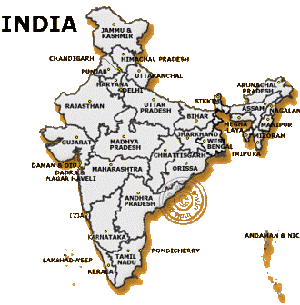
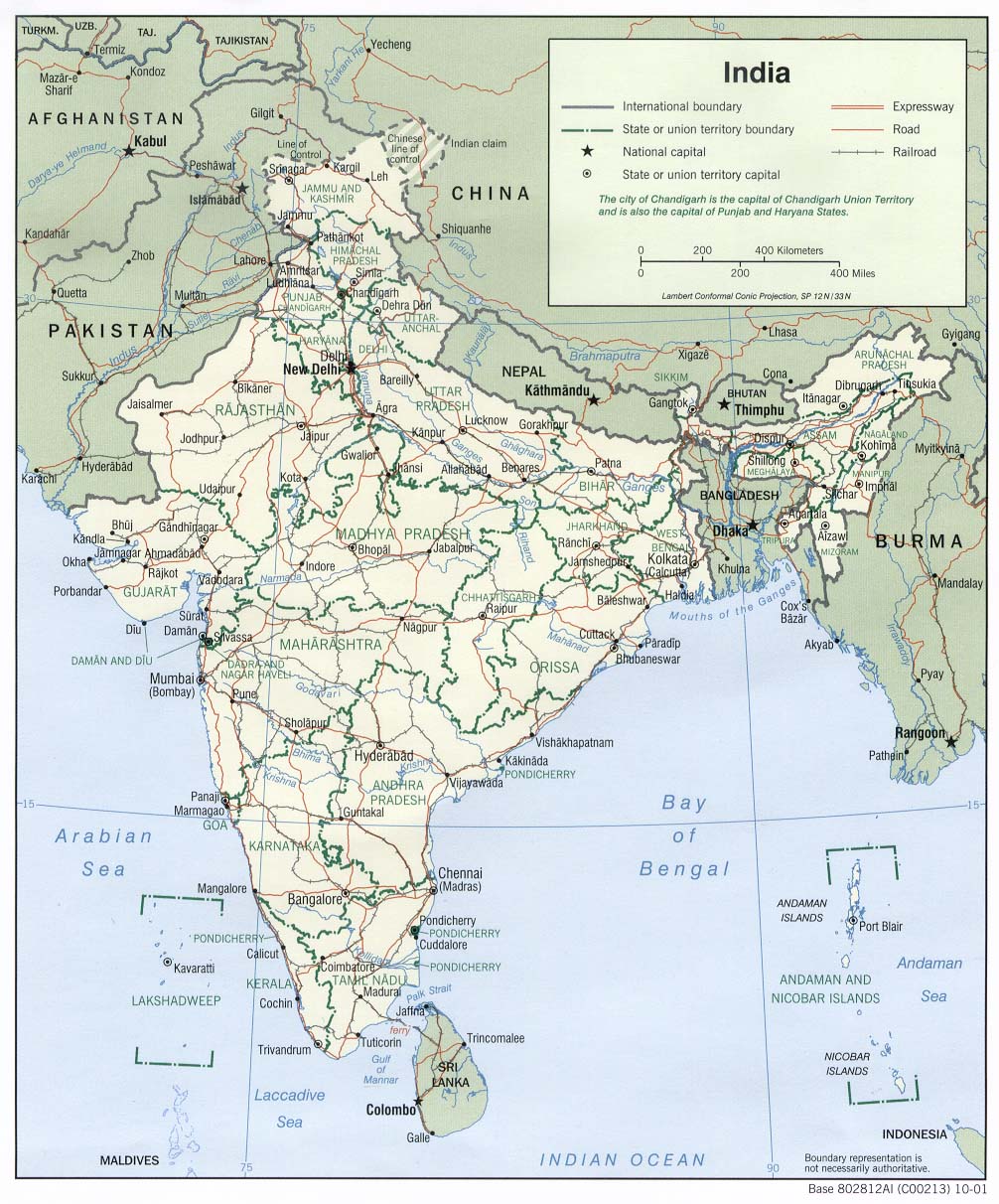
Agencies CIA, CNN & BBC chopped off Kashmir from India!


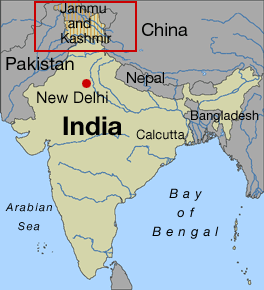
CIA's map: Northern Kashmir is shown cut off from the state and the territory forming part of Pakistan and China. In the 1962 war, China illegally occupied "Aksai Chin", the land rightfully belonging to India. Here CIA has referred to it as 'Indian claim'.


CNN's map: CNN has shown the entire state of Jammu and Kashmir as 'Disputed'. This defies the partition of India and Pakistan in accordance with the 'Indian Independence Act of 1st July 1947, passed by the British Parliament.


BBC - India Map
BBC - India Map


BBC's map: Northern Kashmir is termed as "Pakistani Kashmir". This land is well-knowned as Pakistan Occupied Kashmir (POK). But BBC has called it as "Pakistani" ie. belonging to Pakistan. Legally complete Jammu and Kashmir State belongs to India. Also BBC is silent about China occupied Kashmir.


Indian Government Map: Indian Government map shows complete state of Jammu and Kashmir as part of India with distinct borders. This version is supposed to be official. Now it's Indian Government's duty to clarify about CIA, CNN and BBC versions of Indian map.
Dear Friends,

Take a close look at the maps of Bharat (India) shown on the websites of CIA, CNN and BBC. Is this the true map of the state of Kashmir and the country, which you have learnt, visited since your schooldays?


1) The Central Intelligence Agency (CIA) is an intelligence agency of the United States Government, responsible for obtaining and analyzing information about foreign governments, corporations, and individuals, and reporting such information to the various branches of the Government.
2) CNN is America's No. 1 cable news network and world-renowned news agency.

3) The British Broadcasting Corporation (BBC) is the largest publicly-funded radio and television broadcasting corporation of the United Kingdom. They have deliberately cut off Kashmir from the rest of India and offered it to Pakistan and China.

CIA has published a 'The World Factbook' of the nations of the world. The distorted map of India as shown in this protest campaign is represented in this book. Most of the world's famous websites, search engines universities like Texas etc refer to this map as a "legal" map of India. Almost 90% of the maps of India available around the world reflect this illegal and wrong version.
The partition of India and Pakistan occurred in accordance with the 'Indian Independence Act' passed by the British Parliament on 1st July 1947. There has been no alteration to the international borders set up in 1947 till date.
This is NOT a mistake due to ignorance!


1) CIA, a powerful intelligence agency of the US government and CNN has all the information about foreign governments in their hand.


2) Also to aid researchers, the Indian government has also placed an official map of India on the website.


3) The United Nations (UN) has clearly mentioned in its asian map that the "Final Status of Jammu and Kashmir has not yet been agreed upon by parties." (i.e. India and Pakistan)

Now question is even then why have the "Fact-masters" ignored these official documents and supported Pakistan by upholding their version of map. This clearly indicates CIA, CNN and BBC's prejudiced leanings towards Pakistan and thus that of US.


Be aware of the threat to our country. If we do not stand now, it will be too late. Protect the territory and freedom. Mother India needs your support. Now is the time to make your choice.


Incredible India Wallpapers

India Wallpapers


Indian economy is in a crisis

As you are all aware India like many other Asian countries, India is undergoing a severe economic crunch. Many Indian industries are closing down. the Indian economy is in a crisis and if we do not take proper steps to control those, we will be in a critical situation. More than 30000 crore rupees of foreign exchange is being siphoned out of our country on products such as cosmetics, snacks, tea, beverages...etc which are grown, produced and consumed here.

A cold drink that costs only 70/80 paise to produce is sold for Rs 10, and a major chunk of profits from these is sent abroad. This is a serious drain on Indian economy.

Did you know that "Coca Cola" and "Sprite" belong to the same multinational company,"Coca Cola"? ..On one hand coke advertisements say that 'Jo chaho hojaye, cocacola enjoy' (i.e. whatever the hell, let it happen, you drink coke) ; and on the other hand, Sprite says that 'Bhujao only pyas, baki all bakwas' (i.e. drinks can just quench thirst all other claims are false).What can you do? You can consider some of the better alternatives to aerated drinks.


You can drink lemon juice, fresh fruit juices, chilled lassi (sweet or sour), butter milk, coconut water, jaljeera, enerjee, masala milk..........

Everyone deserves a healthy drink, including you! Over and above all this, economic sanctions have been imposed on us. We have nothing against Multinational companies,but to protect our own interests we request everybody to use Indian products only for next two years. With the rise in petrol prices, if we do not do this, the rupee will devalue further and we will end up paying much more for the same products in the near future. What you can do about it.

1. Buy only products manufactured by Indian companies.

2. ENROLL as many people as possible for this cause.


Each individual should become a leader for this awareness. This is the only way to save our country from severe economic crisis.You don't need to give up your lifestyle. You just need to choose an alternate product.

For example List of products


Bathing Soap
  • Use - Cinthol & other Godrej brands, Santoor,Wipro Shikakai, Mysore Sandal, Margo, Neem, Evita, Medimix, Ganga, Nirma bath, Chandrika.
  • Instead of - Lux, Lifeboy, Rexona, Liril, Dove, Pears, Hamam, LeSancy,Camay, Palmolive

Tooth Paste
  • Use : Neem, Babool, Promise, Vico Vajradanti, Prudent, Dabur Products
  • Instead of : Colgate, Close up, Pepsodent, Cibaca, Forhans, Mentadent.


Tooth brush:
  • Use - Prudent, Ajanta, Promise.
  • Instead of - Colgate, Close up, Pepsodent, Forhans.


Shaving Cream
  • Use : Godrej, Emani.
  • Instead of : Palmolive, Old Spiice, Gillete.

Shaving Blade
  • Use - SuperMax, Topaz, Lazer, Ashoka.
  • Instead of - Seven-O-clock, 365, Gillet.


Talcum Powder
  • Use - Santoor, Gokul, Cinthol, Wipro baby powder, Boroplus
  • Instead of - Ponds, Old Spice, Johnson baby powder, Shower to Shower.


Milk Powder

  • Use - Indiana, Amul, Amulya.
  • Instead of - Anikspray, Milkana, Everyday milk, Milkmaid.

Shampoo:
  • Use - Nirma, ayur, Velvet
  • Instead of - Halo, All Clear, Nyle, SunSilk.

And above all

CLOTHES


Do you know that the cotton is produced in the Indian villages, threads are produced in the Indian towns, dresses are stitched in Indian cities and clothes are purchased by Indian customers. But it is branded as manufactured by a multinational company for which we LOSE precious foreign exchange.


THE money is going to some developed countries. It is TRUE. Please go to the remote areas of cities and see yourself the truth .Thousands of poor innocent Indians are working as tailors for stitching the worlds popular ready made clothes . But they are paid a poor .This is happening because of our ignorance. INDIA is one of the major textile exporter in the world . Our tailors are famous in countries like united states and united kingdom. Then why should we blindly give in to the attraction of foreign brands? PLEASE think about it.

Every Indian product you buy makes a big difference. It saves INDIA. Let us take a firm decision today.

BUY INDIAN TO BE INDIAN

we are not against foreign products.WE are not anti-multinational companies. We are trying to save our Nation. EVERY DAY IS A STRUGGLE FOR A REAL FREEDOM . ..

We achieved our independence after losing many lives.They died painfully to ensure that we live peacefully.The current trend is very threatening . Multinationals call it globalization in India. For Indians like you and me it is recolonization of India. The colonists left india then.But this time time they will make sure they don't make mistakes.who would like to let a "GOOSE THAT LAYS GOLDEN EGGS" slip away


Political freedom is useless without economic independence. Russia , S.korea, Mexico........The list is very long ! Let us learn from their experience and from our history. Let us do the duty of every true nationalist.

Its obvious that u cant give up all of the items mentioned above,so give up at least small items for the sake of our country,our motherland India.


Hindus and Sikhs are Brothers of the Same Family


Sikhs and Hindus are not separate. Guru Govind Singhji brought in Gurumukhi the wisdom and philosophy from our scriptures and Puranas. Are we going to give up this heritage?"
- Master Tara Singh at a meeting in Mumbai on 19th August, 1964

Sikhism and Hinduism are considered as separate religions today. A closer look at the origin of Sikhism shows that Guru Nanak Dev, the founder of Sikhism, had started a reformatory movement. He despised the evils that had crept into Hinduism like the worship of many deities, caste system, fasts, pilgrimage and preached that God is one, eternal and transcends time - the original teachings of the Vedanta. He did not denounce the holy Hindu scriptures but despised their being read without understanding their meaning. Guru Gobind Singh, the tenth and the last Guru, criticised the Hindu dictum of "ahimsa paramo dharma" and was inspired by the Puranas and the Bhagwad Geeta wherein the lord sends saviour whenever there is oppression and injustice. He founded the Khalsa to protect the Hindus from the Muslim tyranny and oppression. Thus the Sikh gurus tried to revive the original spirit and teachings of Hinduism and tried to build a society which was moral, virtuous and strong.

The basis of the tradition established by Shri Guru Nanak Dev is the Sanatana Dharma. The Guru had preached the message of Sanatana Dharma in the language of the masses, in order to raise the flagging spirits of Hindu society in a Punjab relentlessly overrun by Muslim invaders. The nectar-laden words of the nine Gurus who followed were also expressions of Sanatana Dharma. Every verse of the Shri Guru Granth Saheb is testimony to this fact.

Here are some stanzas from the Gurus and the Guru Granth Saheb in which the Hindu-Sikh affinity is evident :

Taha hum adhik tapasya sadhi Mahakal kalika aradhi
- Guru Govind Singh ji
(There I worshipped and did penance to seek Kali.)


Ram katha jug jug atal
Sab koi bhakhat net Suragbas Raghuver kara
Sagri puri samet Jo en Katha sune aur gaave
Dukh pap tah nikat na aave

- Guru Govind Singh ji

(The story of Ram is immortal and everyone should read it. Ram went to heaven along with the whole city. Whoever listens to or sings His story, will be free of sin and sorrow.)

Kahaiya Hinduan daro na ab tum
Im likho pathon dil sain Guru Nanak ki gadi par
Ab hain Tegh Bahadur Unko jo Muhummadi kar lihoon
To ham hain sab sadar Arya Dharma rakhak pragatiyo hain

- Guru Tegh Bahadur

(Hindus, do not fear, Guru Tegh Bahadur is Guru Nanak's successor. If Muslims bother you, I'll take care of them. For I am the protector of Hinduism.)


Tin te sun Siri Tegh Bahadur
Dharam nibaahan bikhe Bahadur Uttar bhaniyo, dharam hum Hindu
Atipriya ko kin karen nikandu Lok parlok ubhaya sukhani
Aan napahant yahi samani Mat mileen murakh mat loi
Ise tayage pramar soi Hindu dharam rakhe jag mahin
Tumre kare bin se it nahin

- Guru Tegh Bahadur's reply to Aurangzeb's ordering him to embrace Islam.

(In response, Shri Tegh Bahadur says, My religion is Hindu and how can I abandon what is so dear to me? This religion helps you in this world and that, and only a fool would abandon it. God himself is the protector of this religion and no one can destroy it.)


Sakal jagat main Khalsa Panth gaje
Jage dharam Hindu sakal bhand bhaje

- Guru Govind Singh Ji

(The Khalsa sect will roar around the world. Hinduism will awaken, its enemies will flee.)


In his autobiography Bachitra Natak, Shri Guru Govind Singh Dev has claimed that he was a descendant of Lord Rama's younger son Lava, and that Guru Nanak Dev was a descendant of Lord Rama's elder son Kusha (2/18-34, 2/52, 4/1-10 and 5/1-10). This statement is confirmed in several other authentic source-books of Sikhism.

Many Sikh intellectuals, including Dr. Gopal Singh and Khushwant Singh have been expressing their views that Sikhism and Islam are close to each other and have much in common while the teachings of the Guru Granth Sahib indicate that the two religions are not only different but opposite.

The Guru Granth Sahib Ji has 1430 pages, out of which the mention of Islam in some context or the other is found from page number 24 to page number 1412. The hymns of the Guru Granth Saheb which mention Islam may be divided into four categories - First, in which the atrocities committed by Babar and other Muslim rulers have been described; Second, in which an effort has been made to see the various Islamic practices such as Namaz, Roza, Haj, Halaal, etc. in the light of Vedanta; Third, in which Islam has been criticised and all have been advised to remain Hindus; and Fourth, in which Islamic concepts and beliefs have been directly or indirectly criticised.

Those who think of Sikhism as a synthesis between Hinduism and Islam will probably be shocked to find Guru Nanak ji Himself claiming that the Kali Yuga was ushered in into India with the advent of Islam, in the poem "Makke-Madine di Goshti . In the same poem, the Guru Ji refers to the Sufis Moinuddin Chishti (of Ajmer) and Shah Madar (of Makanpur) as imposters who were leading Hindus astray with the intention of converting them.

Hindus and Sikhs are brothers of the same family. Clashes between the two would mean clashes within the family. Sikhs are the brothers of the family who took upon themselves the responsibility to protect the family. The other members of the family must show respect to these soldiers for the services rendered by them to the family. We cannot forget their contribution to India's freedom movement; nor can we forget that they were worst hit by the partition of our country in 1947 when it was their homeland Punjab which was torn apart and thousands of Sikhs were killed and many more uprooted from the land of their fore-fathers. But they chose to remain with India and the Hindus. Both the communities inter-dine, inter-marry, observe the same festivals and visit each other's places of worship. Differences between these communities are created by the politicians to meet their selfish purposes. Let us not allow the players of the power game to create a rift in our family.


To know Swatantryaveer Savarkar's views on Sikh Brotherhood go to :


Hindu Sikh Ekta Zindabad
LONG LIVE HINDU-SIKH UNITY !
LONG LIVE INDIA !

Quotes about INDIA

Best collection of India Quotes 
or Quotes about India on the net.

" It is already becoming clearer that a chapter which has a western beginning will have to have an Indian ending if it is not to end in the self-destruction of the human race... At this supremely dangerous moment in history the only way of salvation for mankind is the Indian Way. "

- Dr. Arnold Toynbee ( British Historian : 1889-1975 )


"Many of the advances in the sciences that we consider today to have been made in Europe were in fact made in India centuries ago."

- Grant Duff ( British Historian of India )


"India was China's teacher in religion and imaginative literature, and the world's teacher in trignometry, quandratic equations, grammar, phonetics, Arabian Nights, animal fables, chess, as well as in philosophy, and that she inspired Boccaccio, Goethe, Herder, Schopenhauer, Emerson, and probably also old Aesop."

- Lin Yutang (1895-1976)
author of The Wisdom of China and India.


"In the great teaching of the Vedas, there is no touch of sectarianism. It is of all ages, climes and nationalities and is the royal road for the attainment of the Great Knowledge "

-Thoreau ( American Thinker )


" When I read the Bhagavat-Gita and reflect about how God created this universe everything else seems so superfluous.We owe a lot to Indians who taught us how to count, without which no worthwhile scientific discovery could have been made"

-Albert Einstein, (1879-1955) physicist. In 1905 He published his theory of Relativity.


" The Indian way of life provides the vision of the natural, real way of life. We veil ourselves with unnatural masks. On the face of India are the tender expressions which carry the mark of the Creators hand. "

- George Bernard Shaw ( Famous British Author )


" It is, indeed, a remarkable circumstance that when Western civilization discovers Relativity it applies it to the manufacture of atom-bombs, whereas Indian civilization applies it to the development of new states of consciousness."

--Anonymous.


" From every sentence (of the Upanishads) deep, original and sublime thoughts arise, and the whole is pervaded by a high and holy and earnest spirit...."In the whole world there is no study so beneficial and so elevating as that of the Upanishads. They are destined sooner or later to become the faith of the people."

-- Arthur Schopenhauer (1788-1860)
German philosopher and writer. He was one of the greatest philosophers of the 19th century.


"India of the ages is not dead nor has she spoken her last creative word; she lives and has still something to do for herself and the human peoples."

- Rishi Aurobindo


" When I read the Upanishads, I found a profundity of world view that made my Christianity seem like third grade."

- Huston Smith
( born in China to Methodist missionaries, a philosopher, most eloquent writer, world-famous religion scholar who practices Hatha Yoga. Has taught at MIT and is currently visiting professor at Univ. of California at Berkley )


"India of the Vedas entertained a respect for women amounting to worship; a fact which we seem little to suspect in Europe when we accuse the extreme East of having denied the dignity of woman, and of having only made her an instrument of pleasure and of passive obedience.What! here is a civilization, which you cannot deny to be older than your own, which places the woman on a level with the man and gives her an equal place in the family and in society."

- Louis Jacolliot (1837-1890)