
Delhi is the capital of India and the heart of the Nation. Walk into the majestic capital city New Delhi and you soar high, feeling the attraction of the surroundings. The India Gate pays deference to the soldiers who laid their lives for India in the Afghan war. The Raj Ghat glorifies the memories of Father of the Nation, Mahatma Gandhi. The other historical moments like Red Fort, Qutab Minar, Humayun's Tomb, Lodhi Gardens, Chandni Chawk etc. stand in pride to enliven the Mughal era and Indo-Islamic architecture in India. The Rashtrapati Bhawan and other modern building, shopping centres, Metro Project and huge flyovers present a perfect blend of modernity with tradition.
Delhi as a city has faced many wars, witnessed many thrones and seen many heirs moulding the city in their own way. Still Delhi has resumed its capital status again and again. Today Delhi has two distinct projections that wait for a tourist. Whereas the Old Delhi represents Delhi of Mughal empire with narrow and crowded roads with monuments like Red Fort, Chandni Chawk etc.; New Delhi is an educational, political and administrative hub of India.
Places you can visit while in Delhi:
Rashtrapati Bhawan
 Architecturally an impressive building, Rashtrapati Bhawan stands at a height competitive to the India Gate. This stretch is called the Rajpath where the Republic Day parade is held. Perfectly designed by Edwin Lutyens, its charisma does not fade away whether in summer or winter.
India Gate
 India Gate is a memorial raised in honour of the Indian soldiers martyred during the Afghan war. The green, velvety lawns at India Gate, particularly, offer a popular evening and holiday rendezvous for young and old alike.
Laxminarayan Temple
 Popular as the Birla Mandir, the Laxminarayan Temple was built by the Birla family in 1938, encompassed by a large garden and fountains behind it. The temple attracts thousands of devotees on Janmashtami day, the birthday of Lord Krishna. The Father of the Nation, Mahatma Gandhi, was assassinated in this temple complex in 1948.
Humayun's Tomb
Humayun's Tomb was built in 1565, nine years after Humayun's death by his wife Haji Begum. Designed by a Persian architect named Mirak Mirza Ghiyas, the edifice was a trendsetter of the time. It is believed that all later Mughal monuments, including the Taj Mahal, followed the suite.
Qutub Minar
Qutub Minar
 Located at a small village called Mehrauli in South Delhi, it was built by Qutub-ud-din Aibek of the Slave Dynasty, the ruler of Delhi in 1206. A fluted 72.5 metres red sandstone tower is covered with intricate carvings and verses from the holy Qur'an. Qutub-ud-din Aibak began the construction of this victory tower as a sign of Muslim domination of Delhi to call the faithful to prayer. However, only the first storey was completed by Qutb-ud-din. The other storeys were built by his successor Iltutmish. The two circular storeys in white marble were built by Ferozshah Tughlaq in 1368, replacing the original fourth storey.
The projected balconies in the tower are engraved by exquisite stalactite designs. The bands of calligraphic inscriptions are amazing in perfection with the exquisite stalactite designs seen on the exterior of this tower.
The Qutub Minar is a historical landmark as it is the first monument of Muslim rule in India, also the edifice pioneering the Indo-Islamic architecture in India.
Red Fort
 The Old Delhi projects an image just contrast to the one projected by New Delhi . Undoubtedly, Old Delhi gives an insight into the multifarious culture that aptly characterizes India. Narrow and overcrowded lanes, yet throbbing with life may be repulsive for you. Contrary to this, is the undying attraction of Red Fort that captures your attention. Made in 1639, when Shahjahan decided to shift his capital to Delhi. Within eight years, Shahjahanabad was completed with the Red Fort-Quila-i-Mubarak (fortunate citadel)- Delhi 's seventh fort.
Chandni Chowk
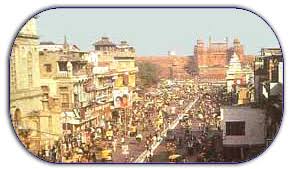 The living legacy of Delhi is Shahjahanabad. Created by Shahjahan, this city, with the Red Fort and Jama Masjid as the principal landmarks, has a fascinating market planned to shine under the light of the moon, called Chandni Chowk. Shahjahan planned Chandni Chowk market for his daughter. Divided by canals filled with water, this place glistened like silver in the moonlight. The canals are now closed, but Chandni Chowk remains Asia's largest wholesale market till date. Crafts once patronized by the Mughals continue to flourish in the small lanes of the city. An experience of timelessness awaits you at Shahjahanabad.
Raj Ghat
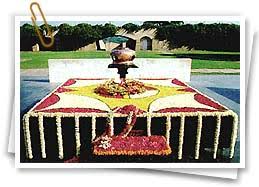 On the bank of the legendary Yamuna, there is Raj Ghat-the last resting place of Mahatma Gandhi, the father of the nation. It has become an essential point of call for all visiting dignitaries. Two museums dedicated to Gandhiji are situated nearby.
Shanti Vana
Beside the Raj Ghat lies the Shanti Vana (literally, the forest of peace), the place where India 's first Prime Minister Jawaharlal Nehru was cremated. The area is now a beautiful park adorned by trees planted by visiting dignitaries and heads of state.
Bahai Temple (Lotus Temple)
 The Bahai Temple, situated in South Delhi resembles a lotus. It is an eye-catching edifice worth exploring dedicated to Bahai community. It offers the visitor a serenity that pervades the temple and its artistic design.
Purana Quila
 The Purana Quila is a fort signifying the medieval military architecture. Built by Humayun, with later-day modifications by Sher Shah Suri, the Purana Quila is a fortress of bold design. Purana Quila is also different from the other forts of the Mughals, as it does not have a complex of palaces, administrative and recreational buildings, as is generally found in the forts built later on. The main purpose of this fort was its utility rather than decoration.
The Qal'a-I-Kunha Masjid and the Sher Mandal are two important monuments inside the fort.
Tughlaqabad
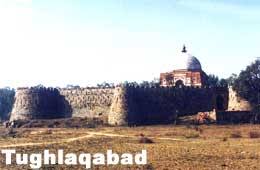 Ghazi Malik built the strongest fort in Delhi at Tughlaqabad, when he founded the Tughlaq Dynasty in 1321. He completed it within four years of his rule. It is said that Ghazi Malik, when only a slave to Mubarak Khilji, had suggested this rocky prominence as an ideal site for a fort. The Khilji Sultan laughed and suggested that the slave build a fort there when he became a Sultan. Ghazi Malik as Ghiyasuddin Tughlaq did just that-Tughlaqabad is Delhi's most colossal and awesome fort, even in its ruined state. Within its sky-touching walls, double-storied bastions, and gigantic towers were housed grand palaces, splendid mosques, and audience halls.
Bahai Temple (Lotus Temple)
The Bahai Temple, situated in South Delhi resembles a lotus. It is an eye-catching edifice worth exploring dedicated to Bahai community. It offers the visitor a serenity that pervades the temple and its artistic design.Purana Quila
The Purana Quila is a fort signifying the medieval military architecture. Built by Humayun, with later-day modifications by Sher Shah Suri, the Purana Quila is a fortress of bold design. Purana Quila is also different from the other forts of the Mughals, as it does not have a complex of palaces, administrative and recreational buildings, as is generally found in the forts built later on. The main purpose of this fort was its utility rather than decoration.The Qal'a-I-Kunha Masjid and the Sher Mandal are two important monuments inside the fort.
Tughlaqabad
Ghazi Malik built the strongest fort in Delhi at Tughlaqabad, when he founded the Tughlaq Dynasty in 1321. He completed it within four years of his rule. It is said that Ghazi Malik, when only a slave to Mubarak Khilji, had suggested this rocky prominence as an ideal site for a fort. The Khilji Sultan laughed and suggested that the slave build a fort there when he became a Sultan. Ghazi Malik as Ghiyasuddin Tughlaq did just that-Tughlaqabad is Delhi's most colossal and awesome fort, even in its ruined state. Within its sky-touching walls, double-storied bastions, and gigantic towers were housed grand palaces, splendid mosques, and audience halls. Places at short distances from Delhi:
Neemrana:
It is one of the oldest heritage resorts of India. This fort-palace is situated on a majestic plateau of the Aravalli ranges and was built in 1464 A.D. by Prithviraj Chauhan lll.
Kesroli:
Kesroli:
It is located in the heart of the 'Golden Triangle' and makes an ideal base to visit the neighboring palaces, museums and sanctuaries of Alwar and Sariska.
Mud Fort:
Mud Fort:
 At a distance of 80 kms from Delhi, this fort is situated in the lush green surrounding of U.P. The banks of Brijghat, 24 kms away on the holy Ganges , make an interesting picnic outing among fields of sugarcane and mango orchards.
Sultanpur:
This bird sanctuary is situated at a distance of 46 kms from Delhi. Here you can see a variety of domestic and migratory birds. The Shallow Lake near the sanctuary becomes a great attraction for the tourists.
Tilyar Lake:
Tilyar Lake:
It is a popular picnic spot located at 70 kms from Delhi . Tourists can enjoy activities like boating and horse riding. Children's Park and a mini-zoo are also attached to the place.
Badhkal Lake:
Badhkal Lake:
 This lake is situated at a distance of about 32kms from Delhi, in the district of Faridabad.It is a popular picnic spot and is surrounded by beautiful gardens and overwhelming serenity.
Surajkund:
 The premises of the Surajkund have a perennial lake surrounded by rock-cut steps. The place is popular for a big fair, which takes place in the first two weeks of February. Surajkund is situated at a distance of about 11kms from the Qutab Minar on the Mehrauli-Badarpur road.


